IV. Conservation
Conservation or restoration?
Conserve wherever possible, repair if required, restore if necessary. Here is what that means in practice, and how we help owners decide.
Three approaches
Conservation is maintaining and managing change to a vehicle in a way that sustains, and where appropriate enhances, its significance. As much original material as possible is kept, and repairs should be reversible wherever they can be. A good rule of thumb is to do no more than is necessary.
Repair fixes what has failed, in like materials and if possible by the same methods as when the car was made, with as little change to original fabric as possible.
Restoration brings a vehicle back to the condition of a chosen point in its life, usually as it left the coachbuilder. Evidence of later periods is removed.
Elements of each are often combined on one car. What matters is that the choice is made deliberately, for good reasons, and recorded.
An example of each
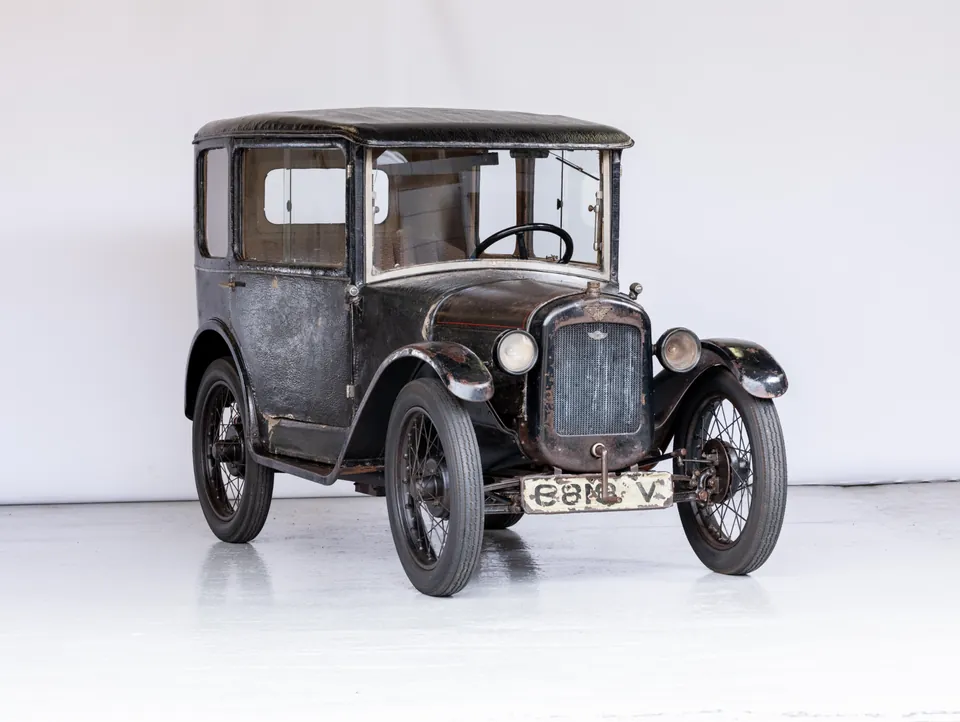
The 1928 Austin Seven was conserved: its fabric body, worn interior and the hallmarks of a working life in Spain have all been kept. The 1927 Bentley boat-tail was restored, because a heavy 1980s rebuild had already hidden its original form, and three period photographs showed exactly how it should look.
How we decide
Four values
Historic England uses these values to judge what makes a building significant. We apply them to motorcars.
Evidential value
How the vehicle reveals evidence about past human activity.
Historical value
The stories these vehicles tell, connecting people and their lives, past, present and future.
Aesthetic value
The sensory and intellectual stimulation that a vehicle or object can evoke.
Communal value
All that a car, bicycle or piece of automobilia means to those for whom it features in experience and memory.
Questions owners ask
What is the difference between conservation and restoration?
Conservation keeps a vehicle as it has come down to us, managing change so that its significance is sustained and its original material kept. Restoration returns a vehicle to how it looked at a chosen point in its life, which usually means removing later evidence. Repair sits between the two: fixing what is broken, in like materials and methods, while keeping as much original fabric as possible.
Should I restore my pre-war car or keep it original?
It depends on the car. A highly original survivor, like the never-restored 1901 Darracq we sold or the 1928 fabric-bodied Austin Seven we conserved, carries evidence that restoration would remove for ever. A car that has already been heavily restored, like the Bentley boat-tail with its 1980s rebuild, may benefit from restoration back to its first appearance. We talk this through with every owner, using the four values below.
Can a car be conserved and still be driven?
Often, yes. Careful recommissioning can keep an original car working: the Darracq completed seven London to Brighton runs without ever being restored. We will be honest about where use and preservation pull in different directions.
Will you restore my car if that is what I want?
We will always give our view, but it is your car. Our motto is conserve wherever possible, repair if required, restore if necessary, and we are equally at home doing all three.
Visit the workshop
Not sure which is right for your car?
Julian is happy to look at your car with you and talk through the options before anything is decided.